


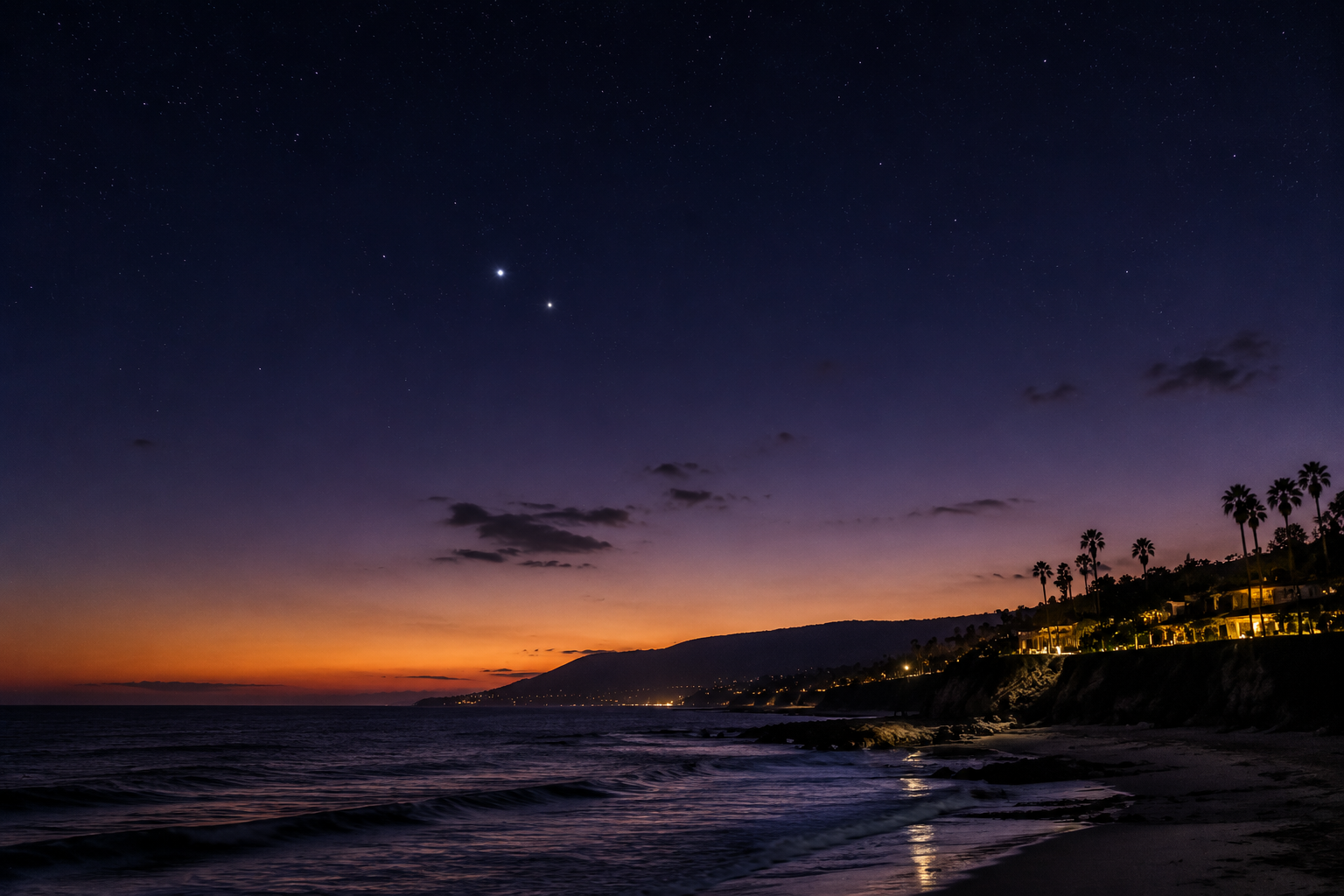
This June, the night sky is offering something that requires no telescope, no app, and no expertise — just a clear evening, an unobstructed view of the western horizon, and a willingness to look up. Two of the solar system’s most brilliant planets are about to put on a show that casual stargazers and seasoned astronomers alike will not want to miss.
On June 8 and 9, Venus and Jupiter — the two brightest planets visible from Earth — will appear approximately three moon-widths apart from each other in the sky, close enough that many observers will initially mistake them for a single blazing object in the twilight. The event is called a conjunction, and while the word sounds technical, the sight itself is anything but — it is one of those rare astronomical moments that stops people in their tracks.
The good news is that the countdown has already begun. As of tonight, Venus, Jupiter, and Mercury are already visible together in the western sky after sunset, with Venus rapidly closing the gap toward Jupiter night by night. Anyone who steps outside this week on a clear evening will be able to watch the two planets inching closer toward each other — a slow-motion celestial approach that makes the June 9 payoff all the more satisfying.
Knowing where and when to look makes all the difference. Step outside roughly an hour after sunset and face west-northwest. Two intensely bright points of light will be sitting about 15 degrees above the horizon — Venus slightly to the upper right of Jupiter, both outshining every star in the sky around them. Binoculars will enhance the view, but they are absolutely not required. This is one of those events designed by nature for the naked eye.
The viewing window is tight — roughly one hour separates sunset from the moment the two planets dip below the horizon — which is why picking a spot with a clean, unobstructed western view matters. Trees, hills, or buildings blocking the lower sky will cut that window short. A rooftop, an open park, or any elevated westward-facing spot will give the best experience.
The sky does not go quiet after June 9 either. On June 16, a thin crescent moon will join Jupiter and Mercury to form a triangle in the evening sky, and on June 17, the moon will appear just above Venus — giving anyone who clouds out on the main event a second reason to keep checking the western horizon throughout the month.
But for Jupiter specifically, time is running out in more ways than one. Jupiter is heading toward solar conjunction on June 24, the date when it passes behind the Sun from Earth’s perspective. As it approaches that point each night, it sinks lower in the western sky and gradually fades from easy view before disappearing entirely into the Sun’s glare. The June 9 conjunction may well be the last clean, comfortable look at Jupiter available until it reappears before dawn in mid-August.
In reality, Venus and Jupiter are nowhere near each other in space — the apparent closeness is purely a trick of perspective, a consequence of viewing a vast three-dimensional solar system projected onto the flat canvas of the night sky. But on a warm June evening, standing outside with two brilliant planets glowing side by side above the darkening horizon, perspective is everything.
Sources: EarthSky, BBC Sky at Night Magazine, Telescope Advisor
