


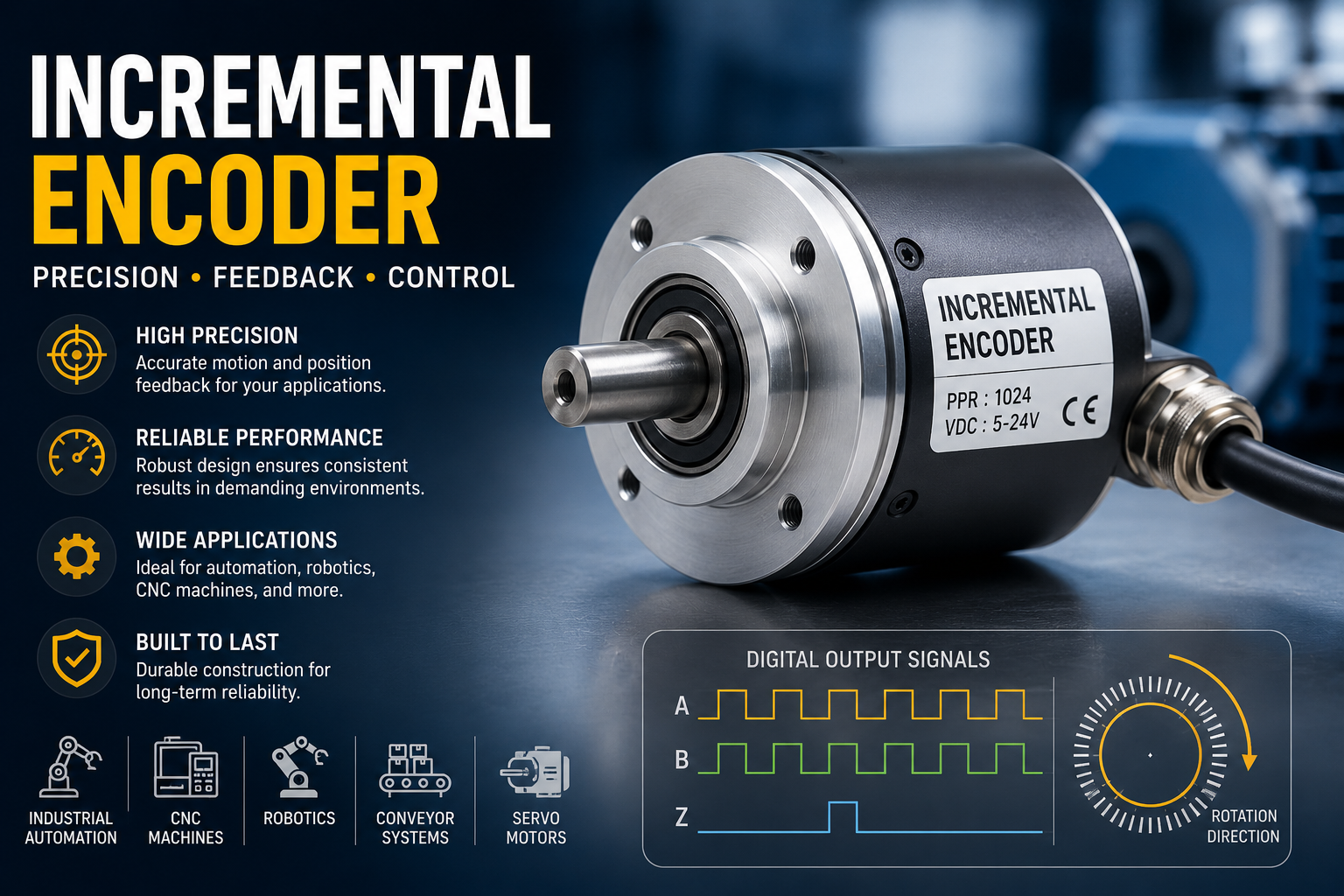
Modern automation systems depend heavily on accurate motion tracking and positioning. From industrial robotics to CNC machines and medical equipment, precision is the foundation of efficient performance. One technology that plays a critical role in this process is the Incremental Encoder.
This device may look small, but it has a massive impact on industrial automation, manufacturing systems, robotics, and even consumer electronics. It helps machines understand movement, speed, direction, and position with remarkable accuracy. Without it, many automated systems would struggle to maintain reliable control.
As industries continue moving toward smarter automation and Industry 4.0 technologies, the demand for accurate sensing devices is growing rapidly. Engineers, technicians, and manufacturers increasingly rely on encoder technology to improve productivity, reduce errors, and optimize machine performance.
| Feature | Description |
|---|---|
| Main Purpose | Measures motion and position |
| Common Use | Industrial automation and robotics |
| Output Type | Pulse signals |
| Motion Detection | Rotation and linear movement |
| Key Benefit | High precision control |
| Typical Applications | CNC machines, motors, conveyors |
| Signal Types | A, B, and Z channels |
| Major Advantage | Cost-effective motion tracking |
What Is an Incremental Encoder?
An Incremental Encoder is an electronic sensing device used to detect rotational or linear motion. It generates electrical pulse signals whenever movement occurs. These pulses are then interpreted by controllers, PLCs, or monitoring systems to determine speed, distance, position, or direction.
Unlike absolute encoders that provide a unique position value, incremental encoders track movement relative to a starting point. This means the system counts pulses to calculate changes in position.
The technology is widely used in:
- Industrial machinery
- Servo motors
- Robotics
- Packaging systems
- Conveyor belts
- Automotive systems
- Medical devices
Because of its precision and affordability, this encoder type has become one of the most commonly used motion control devices worldwide.
How Incremental Encoders Work
The working principle is based on pulse generation. Inside the encoder, there is usually a rotating disc with evenly spaced slots or markings. A sensor detects these markings as the disc rotates and converts them into electrical pulses.
Each pulse represents a small amount of movement. By counting pulses, a controller can determine:
- Speed
- Position
- Rotation angle
- Direction of movement
Most systems use two output channels called:
- Channel A
- Channel B
These channels are slightly offset from each other, allowing the controller to identify rotation direction.
Some encoders also include:
- Z channel (index pulse)
- Reference markers
- High-resolution pulse output
This setup enables highly accurate motion monitoring in automated systems.
Main Components of an Incremental Encoder
Several important components work together inside the device to create accurate signals.
Rotating Disc
The rotating disc contains evenly spaced markings or slots. As the shaft moves, the disc rotates along with it.
Sensor System
Optical or magnetic sensors detect movement on the rotating disc and convert it into electrical signals.
Output Circuit
The output circuitry sends pulse signals to external controllers or monitoring systems.
Shaft Assembly
The shaft connects the encoder to the machine or motor being monitored.
Housing
The outer body protects internal components from dust, vibration, moisture, and industrial conditions.
Types of Incremental Encoders
Different industries require different encoder designs depending on the environment and application.
Optical Encoders
Optical encoders use light sensors and coded discs to generate signals. These are highly accurate and commonly used in industrial automation.
Advantages include:
- High precision
- Fast response
- Excellent resolution
However, they may be sensitive to dust and contaminants.
Magnetic Encoders
Magnetic versions use magnetic fields instead of light.
Benefits include:
- Better resistance to dirt
- Improved durability
- Reliable performance in harsh environments
These are commonly used in automotive and outdoor applications.
Rotary Encoders
Rotary models measure rotational movement and are widely used in motors and machinery.
Linear Encoders
Linear encoders measure straight-line movement instead of rotational motion.
They are often found in:
- CNC machines
- Semiconductor manufacturing
- Precision positioning systems
Why Incremental Encoders Are Important
Modern industries depend on automation for efficiency and accuracy. Motion control systems require real-time feedback to operate correctly.
An encoder provides this feedback by continuously tracking movement.
Without accurate feedback:
- Motors may lose synchronization
- Robots may misalign
- Production lines may become inaccurate
- Machine errors may increase
Incremental encoder systems help maintain:
- Precision
- Repeatability
- Stability
- Operational safety
This is why they are essential in industrial automation environments.
Common Applications of Incremental Encoders
Encoder technology is used in countless industries worldwide.
Industrial Automation
Factories use encoders in automated systems for:
- Position tracking
- Conveyor synchronization
- Robotic movement
- Packaging operations
Robotics
Robots require precise motion control for accurate operation.
Encoders help robotic systems:
- Detect joint movement
- Control arm positioning
- Maintain movement consistency
CNC Machines
Computer Numerical Control machines depend on accurate positioning to cut materials precisely.
Encoders improve:
- Tool positioning
- Cutting accuracy
- Operational consistency
Elevators and Lifts
Elevator systems use motion sensors to monitor speed and floor positioning safely.
Medical Equipment
Many medical machines require extremely accurate movement control for safe operation.
Examples include:
- MRI systems
- Surgical robots
- Laboratory automation devices
Renewable Energy Systems
Wind turbines and solar tracking systems also use motion sensing devices to improve efficiency.
Advantages of Using Incremental Encoders
There are several reasons why industries prefer incremental technology.
Cost-Effective
These encoders are generally less expensive than absolute encoders while still providing excellent performance.
High Speed Performance
They can process rapid motion effectively, making them suitable for high-speed automation systems.
Easy Integration
Most controllers and PLCs can easily interface with encoder systems.
Compact Design
Their small size makes installation easier in limited spaces.
Reliable Motion Tracking
They provide dependable feedback for position and speed monitoring.
Limitations of Incremental Encoders
Despite their advantages, there are some limitations.
Position Loss During Power Failure
Since position tracking depends on pulse counting, the system may lose its exact position after power loss.
Requires Reference Point
Most systems require a homing or reference procedure during startup.
Signal Interference
Electrical noise can affect signal quality in some industrial environments.
Engineers often solve these issues using shielding, filtering, and backup systems.
Resolution and Accuracy Explained
Resolution refers to the number of pulses generated per revolution.
Higher resolution means:
- Greater precision
- Better motion control
- More accurate positioning
For example:
- 100 PPR = lower precision
- 5000 PPR = high precision
PPR stands for Pulses Per Revolution.
Selecting the correct resolution depends on the application requirements.
Incremental Encoder vs Absolute Encoder
People often compare incremental and absolute encoders because both measure motion.
Here are the main differences:
| Feature | Incremental Encoder | Absolute Encoder |
|---|---|---|
| Position Tracking | Relative | Absolute |
| Cost | Lower | Higher |
| Power Loss Recovery | Loses position | Retains position |
| Complexity | Simpler | More advanced |
| Speed Performance | Excellent | Very good |
| Common Usage | Industrial automation | High-precision positioning |
Both technologies are valuable, but incremental models remain popular because of their affordability and efficiency.
The Future of Encoder Technology
Automation continues evolving rapidly. Smart factories, robotics, and AI-driven manufacturing systems are increasing demand for advanced motion control technologies.
Future encoder developments may include:
- Wireless connectivity
- AI-based diagnostics
- Improved durability
- Higher resolutions
- Better energy efficiency
Industry 4.0 systems increasingly rely on real-time data, and encoder technology will remain critical in this transformation.
As factories become smarter, motion control devices will continue improving in speed, precision, and connectivity.
Choosing the Right Encoder
Selecting the correct encoder depends on several factors.
Important considerations include:
- Resolution requirements
- Environmental conditions
- Shaft type
- Speed range
- Mounting style
- Signal compatibility
Industrial environments with dust, moisture, or vibration may require magnetic encoders instead of optical models.
Understanding application needs helps engineers choose the best solution.
Conclusion
The Incremental Encoder has become one of the most important technologies in modern automation and motion control systems. Its ability to track movement accurately makes it essential for robotics, industrial machinery, medical systems, and precision manufacturing.
As industries continue embracing automation and smart technologies, the demand for reliable motion sensing solutions will only grow stronger. Incremental encoders provide the balance of affordability, precision, and performance that modern systems require.
Whether used in high-speed conveyor systems or advanced robotic arms, this technology continues shaping the future of industrial innovation and intelligent automation.
FAQs About Incremental Encoder
1. What is an Incremental Encoder used for?
It is mainly used to measure speed, position, direction, and motion in industrial and automation systems.
2. How does an Incremental Encoder work?
It generates electrical pulse signals as a shaft rotates or moves, allowing controllers to calculate movement and speed.
3. What is the difference between incremental and absolute encoders?
Incremental encoders track relative movement, while absolute encoders provide exact position data even after power loss.
4. Where are incremental encoders commonly used?
They are widely used in robotics, CNC machines, conveyor systems, elevators, and industrial automation equipment.
5. What does PPR mean in encoder technology?
PPR stands for Pulses Per Revolution, which indicates the encoder’s resolution and precision level.
6. Are incremental encoders accurate?
Yes, they provide highly accurate motion feedback, especially in high-resolution industrial applications.
7. Which is better: optical or magnetic encoders?
Optical encoders offer higher precision, while magnetic encoders perform better in dusty or harsh environments.
